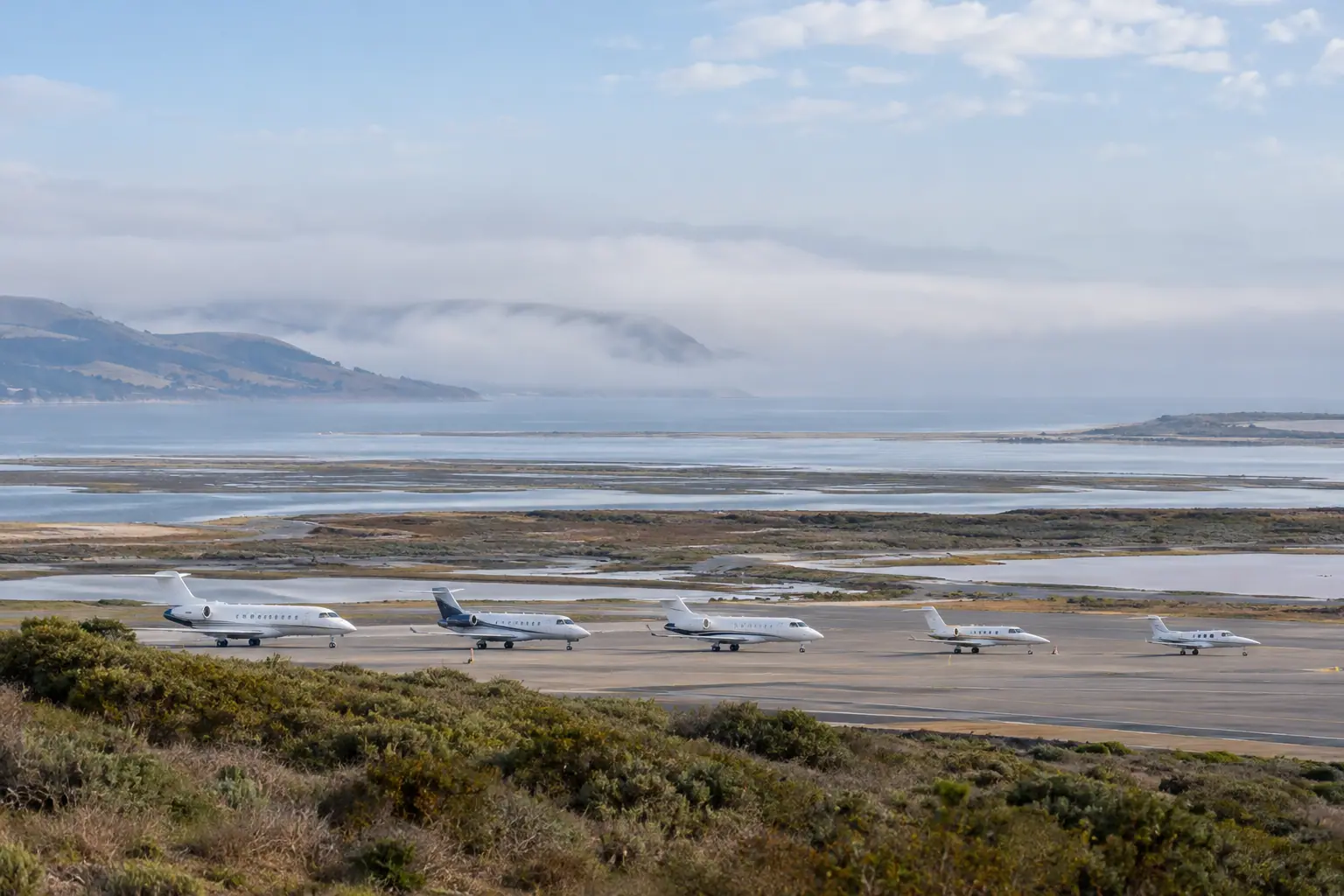
Private jet aircraft San Francisco
Matching a private jet aircraft in San Francisco starts with range. A light jet cruises near 430 knots and covers about 1,400 nautical miles. This page sets out the ten airframes we quote most often.
- Home
- Aircraft
The aircraft list here is the working set we pull from when a client calls about a Bay Area departure. Some flights need nothing more than a turboprop hop to Sacramento or Monterey; others need a heavy jet that can cross the country without a fuel stop. Rather than lead with a favorite airframe, we start with the mission and then narrow the field. Every operator we book holds FAA Part 135 authority and keeps operational control of the flight, while we act as your agent under DOT Part 295 rules for charter brokers.
Two things shape most San Francisco decisions. The first is runway and field choice: SFO, Oakland and Hayward sit close to sea level, while Buchanan Field in Concord is at 26 feet, so summer density altitude is rarely a constraint here the way it is in mountain towns. The second is distance. If your trip is under 1,400 nautical miles, a light jet keeps the cost down and still puts you at the destination inside a few hours. Beyond that, step up to a midsize or larger cabin for range and comfort.
Turboprop
Turboprops run $2,200 to $3,500 an hour and cruise around 300 knots, with roughly 1,500 nautical miles of range for six to eight passengers. They are the sensible choice for short Bay Area legs and regional hops where a jet's speed never gets a chance to pay off. On a route like Fresno or Sacramento, a turboprop can be the economical answer; on a 1,400-mile trip, the slower cruise adds real time.
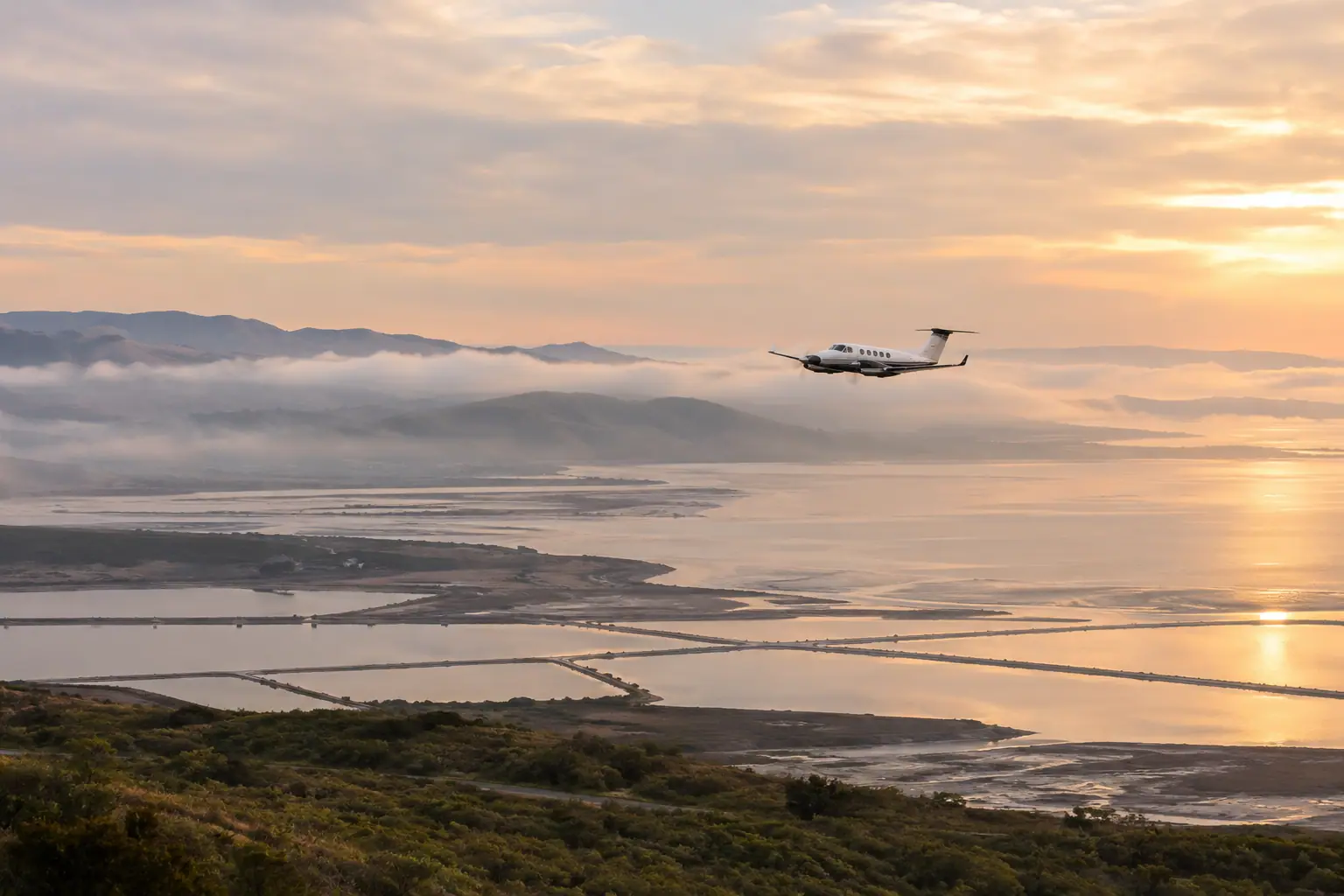
Pilatus PC-12 NGX
- 6 seats
- 290 kt cruise
- 1,800 nm range
The PC-12 NGX seats six, cruises at 290 knots and reaches 1,800 nautical miles, with 40 cubic feet of baggage and a 4 ft 10 in cabin. It is often the first call for a single-engine turboprop trip, though passengers who want cabin space should compare it against a light jet before deciding.
Daher TBM 960
- 6 seats
- 330 kt cruise
- 1,730 nm range
Light jet
Light jets are the volume category for a private jet aircraft San Francisco itinerary: $3,800 to $5,800 an hour, 430 knots, about 1,400 nautical miles, four to seven seats. Los Angeles at 285 nautical miles runs one hour and roughly $4,000 to $6,000. They are efficient, but the cabin is compact, so tall passengers should look at the CJ4 cabin dimensions before committing.
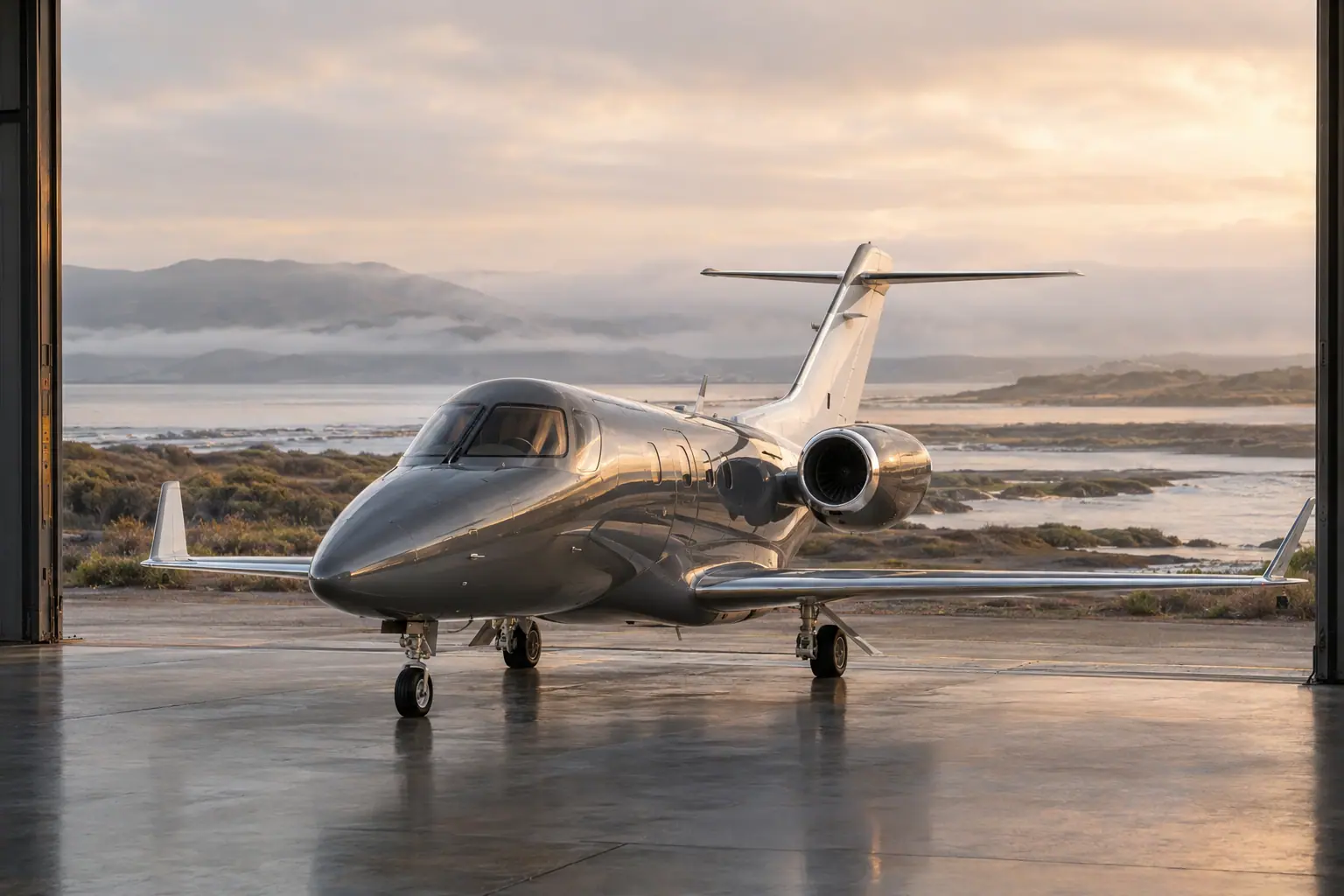
Pilatus PC-24
- 8 seats
- 440 kt cruise
- 2,000 nm range
HondaJet Elite II
- 5 seats
- 422 kt cruise
- 1,550 nm range
The HondaJet Elite II carries five at 422 knots with 1,550 nautical miles of range, a 4 ft 10 in cabin and a generous 66 cubic feet of baggage. It is a strong pick for the short California corridors, where its efficiency and small footprint matter more than cabin volume on a one-hour flight.
Midsize jet
Midsize jets sit at $5,200 to $7,800 an hour with 440-knot cruise, around 2,100 nautical miles and seven to nine seats. The extra range opens Denver at 810 nautical miles in about two hours and seventeen minutes for $8,500 to $13,000. Standing headroom and a real baggage hold make the hour-by-hour experience better on two-hour-plus legs than a light jet.
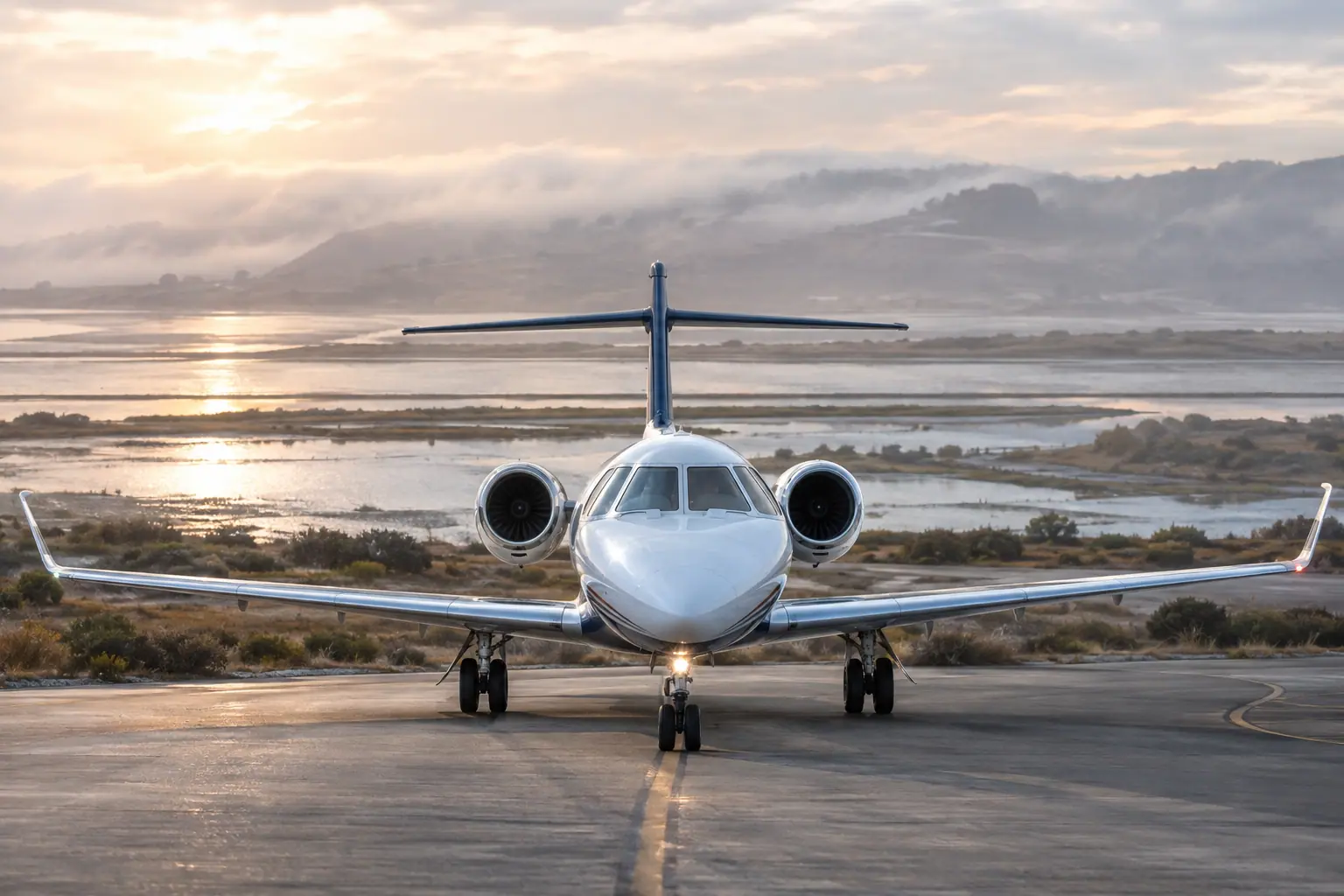
Cessna Citation XLS+
- 8 seats
- 441 kt cruise
- 2,100 nm range
The Citation XLS+ seats eight, cruises at 441 knots and reaches 2,100 nautical miles, with 90 cubic feet of baggage and a 5 ft 8 in cabin. The baggage hold is unusually large for the class, which matters on ski and golf trips where the luggage outruns the passenger count.
Cessna Citation Latitude
- 9 seats
- 446 kt cruise
- 2,700 nm range
Super-midsize jet
Super-midsize aircraft run $7,200 to $10,000 an hour, cruise near 470 knots, and offer 3,200 nautical miles with eight to ten seats. That is the sweet spot for transcontinental nonstops and for West Coast to Hawaii planning where a light jet simply cannot go the distance. Cabins are tall enough to stand and move, and baggage capacity climbs noticeably over midsize.
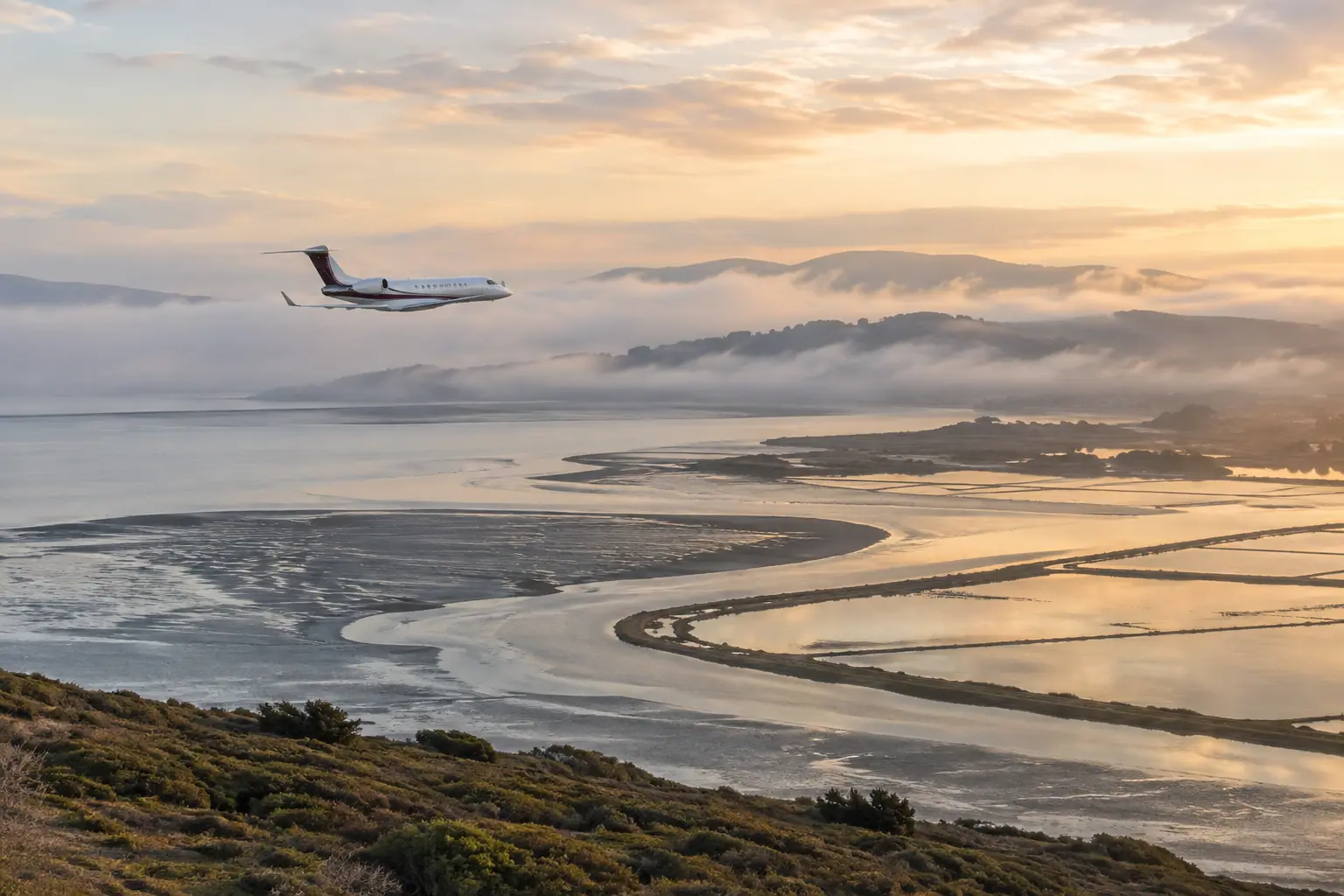
Cessna Citation X+
- 9 seats
- 527 kt cruise
- 3,460 nm range
The Citation X+ seats nine and is the fastest airframe on this list at 527 knots, with 3,460 nautical miles of range and 82 cubic feet of baggage. When a schedule is tight, that cruise speed shortens long legs meaningfully. The 5 ft 8 in cabin is the trade-off for the speed.
Bombardier Challenger 350
- 10 seats
- 470 kt cruise
- 3,200 nm range
Heavy jet
Heavy jets start around $9,500 and reach $14,500 an hour, with 4,000 nautical miles of range and ten to fourteen seats. This is the class for coast-to-coast with a full cabin, or for international legs that need CBP clearance on arrival. A New York run of 2,205 nautical miles fits comfortably, and the cabin becomes a working space rather than a seat.
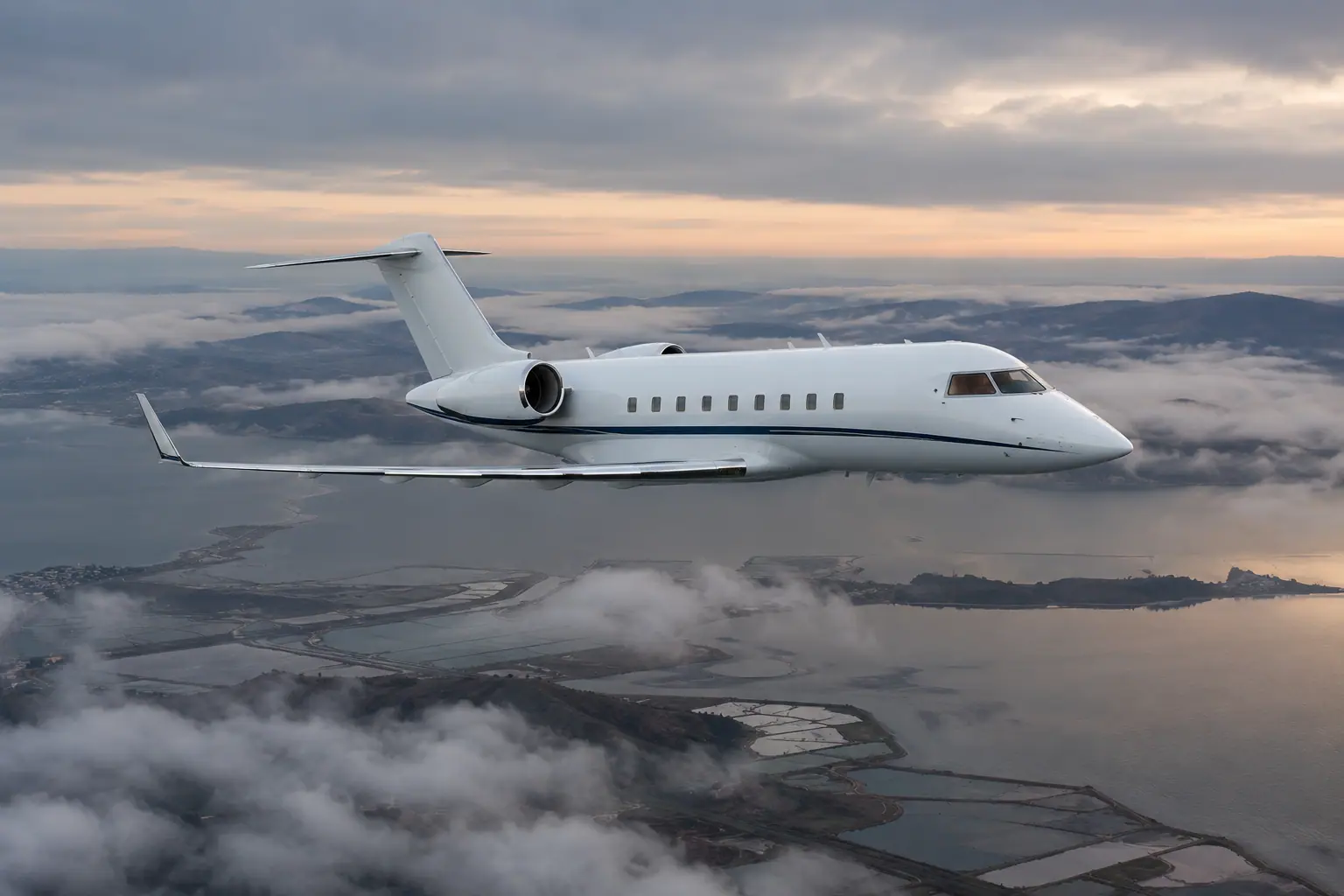
Dassault Falcon 900LX
- 12 seats
- 459 kt cruise
- 4,750 nm range
The Falcon 900LX seats twelve, cruises at 459 knots and offers 4,750 nautical miles, the longest range here, with 127 cubic feet of baggage and a 6 ft 2 in cabin. Three engines and that range make it the choice for international legs, including trips that clear CBP on return to the Bay Area.
Gulfstream G450
- 14 seats
- 476 kt cruise
- 4,350 nm range
Choosing between speed, cabin and range
Start with the longest leg of the trip, then work backward to the smallest aircraft that covers it without a fuel stop. A private jet aircraft San Francisco travelers book for a Los Angeles run does not need 4,000 nautical miles of range, and paying for it is money spent on capability you never use. If your trip is Phoenix at 549 nautical miles, then a light jet at $6,000 to $9,500 handles it in about an hour and thirty-eight minutes, and a heavy jet adds cost without adding much.
Cabin size is the second filter, and it is where most disagreements with clients get resolved. If four tall adults are flying to Aspen at 716 nautical miles, then the 4 ft 9 in cabin of a light jet becomes a real comfort question, and a midsize or super-midsize earns its hourly rate on that San Francisco route. Ask about baggage volume too, especially on a Turks and Caicos run at 2,732 nautical miles where dive gear and luggage compete for the 115 cubic feet of a Challenger 650.
Questions
What private jet aircraft San Francisco travelers book most often?
Light jets are the most quoted class for Bay Area departures, running $3,800 to $5,800 an hour with about 1,400 nautical miles of range and four to seven seats. On a 285-nautical-mile Los Angeles leg, expect roughly one hour of flight time and an estimated $4,000 to $6,000. Pricing is an estimate and firms once an operator and tail number are assigned.
How much does a private jet from New York to San Francisco cost?
A light jet on the 2,205-nautical-mile route runs an estimated $24,500 to $37,500 with about six hours and twenty-six minutes of flight time. Many clients move up to a super-midsize or heavy jet for that distance since the cabin matters on a six-hour leg. Treat these as estimates until the operator confirms the quote.
Which Bay Area airports can a private jet use?
SFO, Oakland, Hayward and Buchanan Field all handle private aircraft, and Oakland, Hayward and Concord offer the most convenient general aviation access. Hayward's longest runway is 5,694 feet and Buchanan Field's is 5,001 feet, so both suit light and midsize jets. SFO's 11,870-foot runway accommodates any aircraft on this list.
Can a light jet fly from San Francisco to Cabo San Lucas?
The route is 1,093 nautical miles, which sits inside the range of a Citation CJ4 Gen2 at 2,165 nautical miles, so a light jet can make it. Expect about two hours and fifty-eight minutes and an estimated $11,500 to $17,000. International legs require CBP coordination for the return, and passengers should carry valid passports.
What is the fastest aircraft available for a long Bay Area leg?
The Citation X+ cruises at 527 knots, the highest on this list, with 3,460 nautical miles of range. On a 2,205-nautical-mile New York route, that speed shortens block time against slower heavy jets. It seats nine, so larger groups should weigh a Challenger 650 at 470 knots and twelve seats instead.
Do empty leg flights out of San Francisco save money?
Empty legs are repositioning flights an operator is already flying, and they can be priced well below a standard charter because the aircraft has to move anyway. Availability is unpredictable and routes are fixed, so they suit flexible travelers. If your dates are firm, then booking a standard charter gives you the aircraft and timing you actually need.